
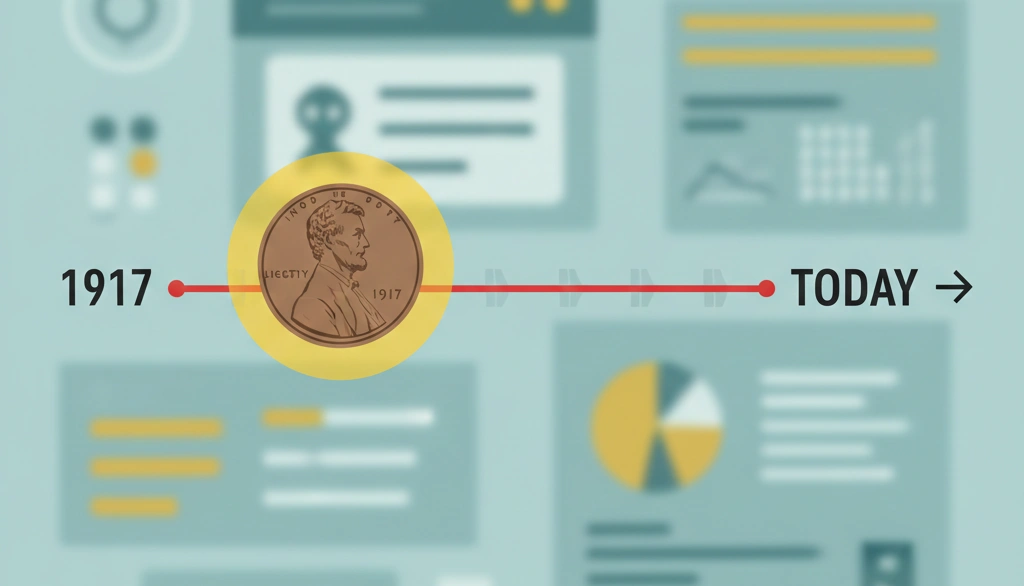
Belonging to the series featuring Victor David Brenner’s design introduced in 1909, the 1917 one-cent issue remains a significant historical artifact. Characterized by the entry of the United States into World War I, this period saw increased economic activity and a heightened demand for small-denomination currency.
The coin's composition consists of an alloy made of 95% copper, and 5% tin, and zinc. Each specimen possesses a mass of 3.11 grams. The coin diameter measures 19 millimeters.
A smooth edge characterizes the perimeter of the coin.
The obverse design contains the profile of Abraham Lincoln facing right.
Depending directly on the preservation of the original surface color, the 1917 penny value varies significantly.
Mint | Mark | Mintage |
Philadelphia | None | 196,429,785 |
Denver | D | 55,120,000 |
San Francisco | S | 32,620,000 |
Exceeding 284 million specimens, the total output makes this coin readily available for study across various preservation levels.
Condition Classification and Color Categories
Numismatic standards identify three primary categories:
Brown (BN): Specimens having lost more than 95% of their original red color.
Red-Brown (RB): Coins retaining between 5% and 95% of the initial copper luster.
Red (RD): Specimens preserving more than 95% of the original bright red mint color.
Transitioning from the RB to the RD category can increase the market value of a coin several times within the same numerical grade.
Grade | 1917 (P) RD | 1917-D RD | 1917-S RD |
MS63 | $50 | $450 | $475 |
MS64 | $85 | $850 | $1,100 |
MS65 | $225 | $2,850 | $3,500 |
MS66 | $950 | $14,500 | $22,500 |
These data points indicate a substantial price gap between issues from different mints in high grades.
Analysis of Auction Records
Sales statistics on platforms such as Heritage Auctions and Stack’s Bowers allow for the identification of peak value thresholds for 1917.
Recorded in 2023, the record price for a Philadelphia coin (1917 P) in MS68 RD grade reached 33,600 US dollars.
For the Denver issue (1917-D), the maximum price reached 58,800 US dollars for an MS66+ RD specimen in 2021.
Representing the San Francisco issue (1917-S), the most expensive specimen is an MS66 RD coin sold in 2004 for 25,875 US dollars.
Analyzing sales over the last 15 years, one observes an annual price increase of 4-6% for rare specimens in MS66 and higher grades.
In the medium preservation segment (XF-AU), the price demonstrates stagnation, fluctuating between 2 and 10 dollars over the last decade.
Features and Minting Varieties
No significant doubled die errors comparable to the 1955 or 1972 issues were recorded in 1917.
However, technological deviations possessing confirmed market value occur:
Struck on a Dime Planchet: Coins erroneously struck on silver 10-cent blanks. The price of such samples varies from 2,000 to 5,000 dollars.
Off-center Strikes: Offsets of 10-50% add between 50 and 300 dollars to the value.
Lamination Errors: Metal blank flaking, frequently occurring in copper alloys of that era. The price ranges from 5 to 25 dollars.
Characterized by weak detail execution, especially on the wheat stalks, the strike quality for 1917 Denver and San Francisco issues remains often subpar.
Coins possessing sharp, detailed design lines (Full Strike) are valued 15-25% higher than standard catalog prices.
Investment Analysis and Price Volatility
The liquidity of the 1917 one cent is distributed unevenly across preservation categories.
Possessing minimal investment potential, coins in conditions below MS60 exist in vast quantities.
Investment interest remains focused exclusively on coins in the RD (Red) category with grades of MS65 or higher.
Percentage Price Change (2010–2024/25)
Grade MS63 RD: Growth amounted to 12% over 14 years.
Grade MS65 RD: Growth reached 48% over 14 years (averaging 3.4% annually).
Grade MS66 RD: Growth exceeded 85% due to supply deficits at major auctions.
In real terms, price drops in the BN (Brown) segment reached approximately 5% when adjusted for inflation.
This confirms the necessity of focusing on color for long-term asset holding.
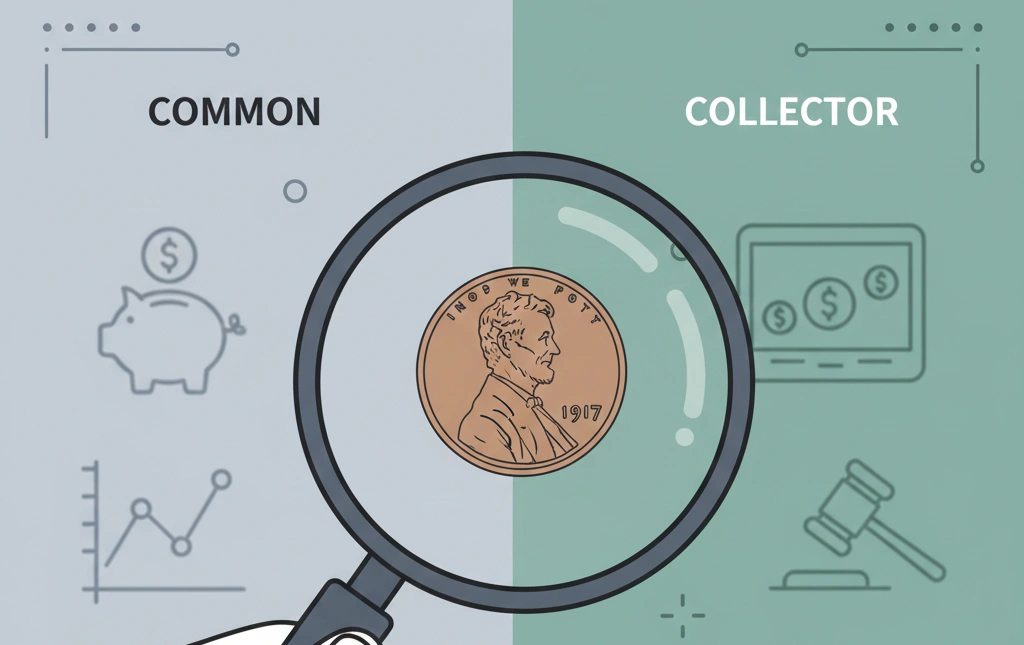
Factors Influencing Copper Coin Grading
The certification process in PCGS or the coin checker app involves checking for signs of cleaning.
Reacting actively to chemicals, copper forms patina or undergoes corrosion.
Specimens possessing signs of artificial luster (Whizzing) or chemical color restoration receive a "Genuine - Details" label and lose up to 80% of their market value.
The presence of microscopic carbon spots on the surface of red (RD) coins remains a critical factor.
Even a single spot on the obverse can lower a grade from MS66 to MS64.
Global Supply and Mintage Survivability
Despite a mintage of 284 million pieces, the actual number of coins available in "as-struck" condition is extremely low.
Actively used in trade operations until the 1950s, most of the 1917 issue suffered from circulation wear.
Coin withdrawal from circulation occurred naturally as a result of wear and tear.
According to expert estimates, fewer than 0.01% of the original mintage survived in MS65 or higher condition.
This creates steady demand in the top price segment in the absence of new large discoveries.
Verification Recommendations
Using professional grading with the coin value app is mandatory for establishing the exact value of a 1917 penny.
Independent determination of color (RD or RB) often leads to valuation errors of 200-300%.
Examining the coin must include inspecting the edge for filing or soldering, sometimes used in attempts to imitate rare mint errors.
Utilizing scales with 0.01-gram precision allows for the exclusion of crude counterfeits made by casting.
The 1917 one cent represents a mass-produced issue with clearly defined rare positions in the highest preservation states.
The value of an ordinary circulated specimen does not exceed 1 dollar.
Growing steadily based on auction data, the market capitalization of rare grades (MS67 and above) remains strong.
The technical state of the dies and storage conditions over a century have shaped the current deficit of Red (RD) coins.
Objective facts confirm that the value of this issue rests on the physical rarity of preservation rather than artificially created demand.